
In modern aquaculture, pond sludge management has become one of the most critical factors affecting fish growth, survival rate, and production efficiency.
Most fish farmers notice problems only when water becomes dark, fish stop feeding, or disease begins to spread. However, by that stage, sludge accumulation at the pond bottom has already reached a critical level.
This guide explains in detail:
- Why sludge builds up faster than expected
- What problems it creates in fish ponds
- Why traditional cleaning methods are becoming less effective
- How modern fish farms remove sludge without draining water
- How to choose the right fish pond cleaning solution
The goal is to help fish farmers understand not just how to clean ponds, but how to manage sludge scientifically for long-term productivity.
Why Sludge Builds Up in Fish Ponds Faster Than Most Farmers Expect?
Sludge formation in fish ponds is not a sudden process—it is continuous, biological, and often underestimated.
1. Feed Conversion Ratio (FCR) Loss
In commercial fish farming, not all feed is converted into biomass. A significant portion becomes waste:
- Uneaten feed sinks directly to the bottom
- Digested feed is partially excreted
- Fine feed particles dissolve into organic matter
This directly increases sludge formation.
2. Fish Manure Accumulation
Fish continuously produce solid waste. In high-density ponds, this waste accumulates faster than natural decomposition can handle.
3. Algae Growth and Die-Off Cycle
Algae plays a dual role:
- During growth: consumes nutrients
- During die-off: becomes organic sediment
Dead algae contributes heavily to bottom sludge layers.
4. Organic Decomposition Process
Once organic matter settles:
- Aerobic bacteria consume oxygen
- Anaerobic bacteria begin breaking down material
- Toxic compounds are released in deeper layers
5. Formation of Anaerobic Bottom Layer
Over time, oxygen cannot penetrate deeper layers, creating:
- Black sludge
- Hydrogen sulfide zones
- Toxic sediment layers
Sludge Formation Logic
Feed
↓
Fish waste + uneaten feed
↓
Organic sediment accumulation
↓
Anaerobic decomposition
↓
Black sludge layer
↓
Ammonia & toxic gas release
↓
Fish disease & slow growth
What Happens If Pond Sludge Is Not Removed?
Sludge is not just “dirt” at the bottom of a pond—it actively changes water chemistry and biological balance.
Reduced Dissolved Oxygen (DO)
Why it happens:
Microorganisms decompose organic matter and consume oxygen during the process.
Result:
- Fish move to surface
- Reduced feeding activity
- Stress behavior increases
Increased Ammonia Concentration
Why it happens:
Organic nitrogen in waste is converted into ammonia during decomposition.
Result:
- Toxic environment
- Gill damage
- Reduced growth rate
Hydrogen Sulfide Production
Why it happens:
In anaerobic sludge layers, sulfur-reducing bacteria produce H₂S gas.
Result:
- Rotten egg smell
- Black sediment
- Fish poisoning risk
Lower Feed Conversion Efficiency (FCR)
Why it happens:
Fish under stress consume more energy for survival instead of growth.
Result:
- Higher feed cost
- Lower yield
Difficult Harvesting
Why it happens:
Thick sludge traps nets and makes bottom conditions unstable.
Result:
- Harvest delay
- Higher labor cost
Higher Disease Risk
Why it happens:
Sludge becomes a breeding ground for pathogens such as Vibrio and Aeromonas.
Result:
- Disease outbreaks
- High mortality risk
Traditional Fish Pond Cleaning Methods
1. Manual Cleaning
Advantages:
- Low equipment cost
- Simple operation
Limitations:
- Extremely labor-intensive
- Low efficiency
- Not suitable for large ponds
- Safety risks in deep sludge areas
2. Excavator Cleaning
Suitable when:
- Pond is fully drained
- Bottom is hard and stable
- HDPE liner is not used
Not suitable when:
- Pond contains water and fish
- HDPE geomembrane is installed
- Soft muddy bottom conditions exist
3. Pond Draining Method
Suitable when:
- Seasonal fish harvesting
- Small-scale ponds
- Complete pond renovation
Why it is being reduced:
Modern aquaculture avoids draining because:
- Production stops for weeks
- Water resource waste
- Fish stress and mortality
- High restart cost
Can Fish Pond Sludge Be Removed Without Draining the Water?
Yes.
Modern aquaculture systems increasingly use underwater sludge removal technologies to clean ponds while keeping them operational.
This approach is widely used in:
- Commercial fish farms
- High-density aquaculture systems
- Continuous production farms
Why it is preferred:
- No production interruption
- No fish transfer required
- Water remains stable
- Lower long-term operating cost
How Fish Pond Cleaning Robots Work?
Modern fish pond cleaning robots integrate mechanical, hydraulic, and remote-control technologies.
Working Process:
Crawler chassis movement
↓
Bottom sludge loosening system
↓
Hydraulic remote sludge pump
↓
Sediment suction system
↓
Long-distance pipeline discharge
Key System Explanation
Crawler Chassis
Ensures stable movement on soft pond bottoms while protecting:
- Earthen pond structure
- HDPE liner systems
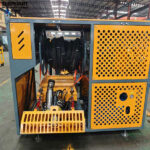
Hydraulic Remote Sludge Pumping System
This is the core system of modern pond cleaning robots.
It enables:
- Long-distance sludge transport
- Continuous discharge operation
- Stable flow without blockage
Sludge can be transported directly to:
- Sedimentation tanks
- Drying beds
- Waste collection areas
Suction & Cutting System
Before suction:
- Compact sludge is loosened
- Sediment layers are broken
- Flowability is improved
Remote Control System
Operators control the entire cleaning process from the pond edge, ensuring:
- Safety
- Precision
- Reduced labor cost
Choosing the Right Fish Pond Cleaning Robot
Selecting the correct system depends on real pond conditions.
Pond Area
Why it matters: Determines total cleaning capacity and working efficiency.
Sludge Thickness
Why it matters: Heavy sludge requires stronger cutting and suction systems.
Pond Bottom Type
- Earthen pond → standard crawler
- HDPE-lined pond → rubber crawler required
- Concrete pond → high-pressure suction preferred
Pumping Distance
Why it matters:
Determines whether a hydraulic remote pumping system is required.
Long-distance farms need higher discharge capacity.
Water Depth
Why it matters:
Affects robot structure size and suction head design.
Daily Cleaning Volume
Why it matters:
Determines required model capacity (m³/h output).
What Features Matter Most in a Fish Pond Cleaning Robot?
Hydraulic Remote Sludge Pumping
Allows continuous sludge transport over long distances without interruption.
Anti-Clogging Pump System
Designed to handle:
- Feed residue
- Algae clusters
- Organic sludge
- Small debris
Low Turbidity Cleaning Design
Reduces water disturbance to prevent fish stress during operation.
Rubber Crawler System
Protects:
- HDPE liners
- Pond bottom structure
- Soft soil environment
HD Camera Monitoring
Provides real-time underwater visibility for accurate cleaning paths.
Modular Cutter System
Adjustable cutting heads for different sludge conditions:
- Soft sludge
- Compact sludge
- Mixed organic sediment
Applications of Fish pond cleaning robots
- Commercial carp farming ponds
- Tilapia aquaculture systems
- Catfish breeding ponds
- Reservoir fish farming projects
- HDPE-lined fish ponds
- Earthen ponds
- Large-scale aquaculture parks
- Government aquaculture projects
- Intensive fish farming systems
How Often Should Fish Ponds Be Cleaned?
Cleaning frequency depends on farming intensity.
Low-density ponds:
Once per year (mainly before harvest)
Medium-density ponds:
Every 6–9 months
High-density intensive farming:
Every 3–4 months
Why frequency matters:
Higher density → faster sludge accumulation → faster oxygen depletion
ROI Analysis (Return on Investment)
Traditional Cleaning Cost:
- Labor cost
- Pond draining downtime
- Fish production loss
- Water replacement cost
Robotic Cleaning System:
- One-time equipment investment
- Low operation cost
- No production interruption
- Reduced labor dependency
Example Comparison:
| Manual cleaning | High | 5–10 days |
| Pond draining | Very high | 10–20 days |
| Robot system | Low | 0 days |
Typical Payback Period:
6–12 months
FAQ about Fish Pond Cleaning Robot
Can fish remain in the pond during cleaning?
Yes, the system is designed for in-water operation without harming fish.
How much sludge can be removed?
It depends on pump capacity, typically measured in m³/h.
Can it clean algae?
Yes, loose algae and organic deposits can be removed.
How far can sludge be pumped?
With hydraulic remote pumping, sludge can be transported over long distances depending on configuration.
Can one robot serve multiple ponds?
Yes, it can be moved between different ponds.
Does it damage HDPE liners?
No, rubber crawler system is designed for liner protection.
Is it suitable for shrimp ponds as well?
Yes, but shrimp ponds may require low-turbidity configuration.
What maintenance is required?
Simple flushing of pump and inspection after operation cycles.
Conclusion
Sludge accumulation in fish ponds is an inevitable process, but its impact on production can be significantly reduced with proper management.
Traditional cleaning methods are increasingly inefficient for modern aquaculture, especially in high-density commercial farms.
By adopting underwater cleaning technology, fish farms can:
- Maintain stable water quality
- Improve dissolved oxygen levels
- Reduce disease risk
- Increase production efficiency
- Avoid pond downtime
If your pond is showing signs of sludge accumulation, upgrading to a fish pond cleaning robot system can be a cost-effective solution for long-term aquaculture sustainability.