
Automatic Chamber Filter Press for Dredging & Industrial Sludge Treatment
Removing sludge from a lake, pond, tank, or settling basin is only the first step. The extracted slurry often contains a large amount of water, making transportation, storage, and disposal more expensive and difficult.
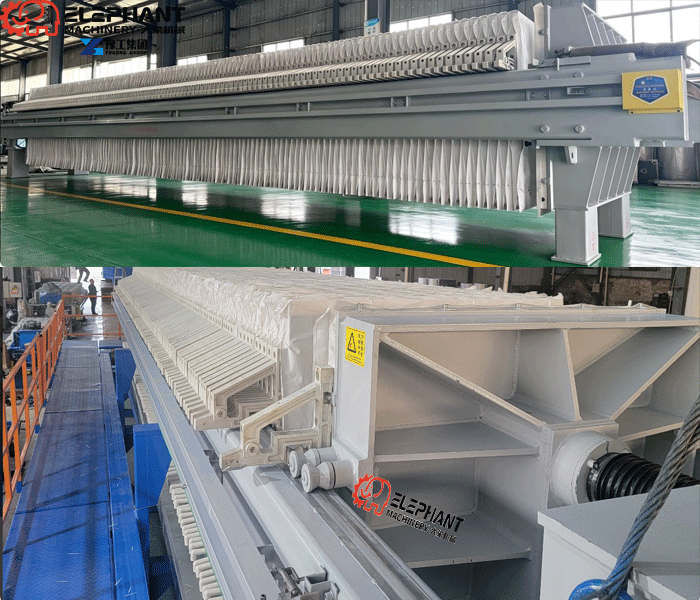
An automatic chamber filter press helps solve this problem by separating suitable sludge into solid filter cake and liquid filtrate. When used with a remote-controlled dredging robot, it creates a more complete sludge removal and dewatering system, from underwater sediment extraction to downstream solids handling and water recovery.
Elephant Dredging offers three automatic chamber filter press models with filtration areas of 100 m², 250 m², and 500 m² to accommodate different processing requirements.
Whether you are cleaning a lake, dredging a tank, treating river sediment, or processing industrial slurry, we can help you select a suitable filter press based on your material characteristics, required capacity, and treatment objectives.
Request a Customized Filter Press Solution
How Does a Filter Press Work with a Dredging Robot?
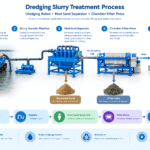
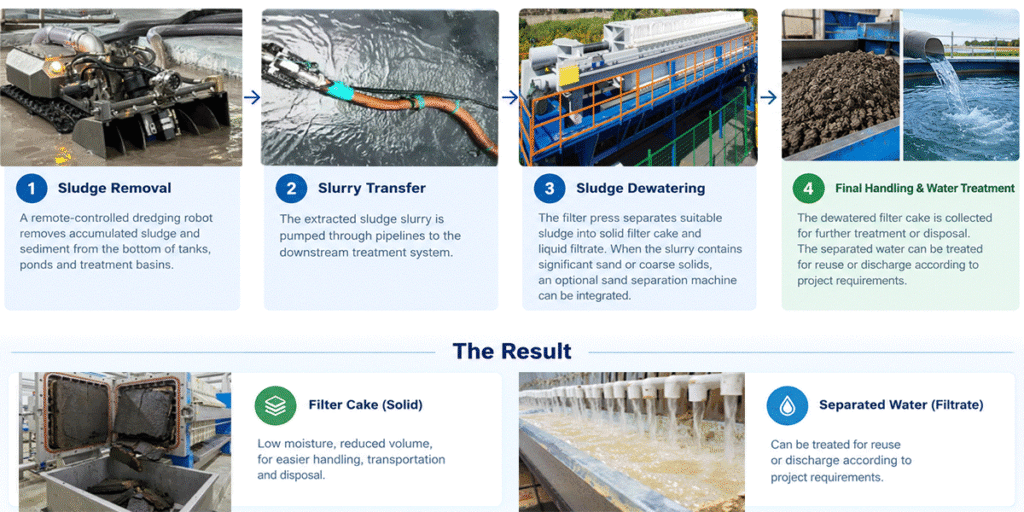
A dredging robot removes accumulated sludge from the bottom of a lake, pond, tank, or treatment basin. The extracted slurry is transferred through a pipeline to the downstream treatment system, where a filter press separates the solids from the liquid.
Step 1: Remove Sludge with a Dredging Robot
The remote-controlled dredging robot collects accumulated sludge and sediment from the bottom of the cleaning area and pumps the slurry through a discharge pipeline.
This approach helps reduce the need for personnel to enter confined or difficult-to-access cleaning areas.
Step 2: Transfer Slurry to the Filter Press
The extracted slurry is conveyed to the treatment area using suitable pumps and pipelines. Depending on the material, a feed tank, mixing system, or other pretreatment equipment may be required.
Step 3: Separate Solids and Water
The filter press applies pressure to the slurry and forces liquid through the filter cloth. Solid particles are retained to form filter cake, while the separated liquid exits as filtrate.
For projects containing significant sand or coarse particles, an optional sand separation machine can be added before the filter press when required.
Step 4: Collect Filter Cake and Manage the Water
The dewatered filter cake can be collected for further handling, transport, recovery, or disposal.
The separated water can be collected and returned to the original lake, tank, or another designated location when its quality meets the applicable requirements. Additional treatment may be necessary before reuse or discharge.
Key Benefits of an Automatic Chamber Filter Press
1. Recover Separated Water
Rather than transporting all the extracted water alongside the sludge, a filter press separates the liquid for reuse or return to the original water body.
This is particularly useful for lake dredging, pond cleaning, and tank cleaning projects where retaining water is important.
2. Build a More Complete Dredging System
Combining a dredging robot with a filter press addresses both sludge extraction and downstream dewatering. Optional sand separation equipment can be included where material characteristics and project requirements justify it.
3. Improve Sludge Handling
Solid filter cake is generally easier to collect, transport, and manage than untreated slurry. The actual cake consistency and moisture content depend on the material and filtration conditions.
4. Support Different Sludge Applications
The three models offer different filtration areas and reference processing capacities for applications such as sand washing, piling, tunnel boring, river dredging, and selected industrial sludge treatment processes.
5. Reduce Sludge Volume
Sludge removed by a dredging robot often contains substantial water. Dewatering helps reduce the amount of wet material that must be transported or disposed of, potentially lowering downstream handling costs.
Get the Right Model for Your Project
Automatic Chamber Filter Press Models
Elephant Dredging offers three models with nominal filtration areas of 100 m², 250 m², and 500 m².
| Specification | YG1000 | YG1250 | YG1500 |
|---|---|---|---|
| Model designation | XMZ100/1000-30U | XMZ250/1250-30U | XMZ500/1500-30U |
| Filtration area | 100 m² | 250 m² | 500 m² |
| Filter plate size class | 1000 | 1250 | 1500 |
| Reference cake thickness | 30 mm | 30 mm | 30 mm |
| Plate-shifting system | Automatic | Automatic | Automatic |
| Filter plate material | Reinforced polypropylene | Reinforced polypropylene | Reinforced polypropylene |
The filtration area refers to the total effective area available for filtration across the filter plates. The appropriate model depends on slurry properties, processing capacity, filtration cycle time, and the required final cake characteristics.
How to Read the Model Number
Using XMZ100/1000-30U as an example:
- X: Chamber filter press.
- M: Open filtrate discharge. The alternative designation A refers to closed discharge.
- Z: Automatic filter plate shifting.
- 100: Nominal filtration area of 100 m².
- 1000: Filter plate size class.
- 30: Reference filter cake thickness of 30 mm.
- U: Reinforced polypropylene filter plate material.
Actual configuration and options should be confirmed when ordering.

Reference Processing Capacity by Application
The following figures are manufacturer-provided reference values for different materials and solids concentrations. They are not guaranteed outputs for every project.
Feed capacity, solid output, and liquid discharge vary with particle size, solids content, filter cloth, filtration pressure, cycle time, and material characteristics. A material test or engineering assessment is recommended before final equipment selection.
YG1000 Automatic Chamber Filter Press — 100 m²
| Application | Approx. Solids Content | Slurry Feed (m³/h) | Solid Output (m³/h) | Water Discharge (m³/h) |
|---|---|---|---|---|
| Coal flotation sludge | 10% | 20 | 3 | 17 |
| Sand washing sludge | 10–15% | 15–20 | 1.5 | 12–18 |
| Piling slurry | 10–15% | 8–10 | 1.5 | 6–8 |
| Tunnel boring slurry | 10–15% | 8–10 | 1.5 | 6–8 |
| River dredging sludge | Around 20% | 6–8 | 1.5 | 4–6 |
| Tailings | Around 25% | 4–6 | 1.5 | 3–5 |
| Lithium battery activated carbon slurry | 10% | 10 | 1.5 | 8 |
Suitable for: Projects requiring a 100 m² filtration area, subject to material testing and the required processing capacity.
YG1250 Automatic Chamber Filter Press — 250 m²
| Application | Approx. Solids Content | Slurry Feed (m³/h) | Solid Output (m³/h) | Water Discharge (m³/h) |
|---|---|---|---|---|
| Coal flotation sludge | 10% | 35–45 | 7.5 | 25–35 |
| Sand washing sludge | 10–15% | 35–45 | 7.5 | 25–35 |
| Piling slurry | 10–15% | 15–25 | 3.75 | 10–20 |
| Tunnel boring slurry | 10–15% | 15–25 | 3.75 | 10–20 |
| River dredging sludge | Around 20% | 12–15 | 3.75 | 10 |
| Tailings | Around 25% | 10 | 3.75 | 6 |
| Lithium battery activated carbon slurry | 10% | 25 | 3.75 | 20 |
Suitable for: Medium-capacity sludge treatment and dewatering projects requiring a larger filtration area than the YG1000.
YG1500 Automatic Chamber Filter Press — 500 m²
| Application | Approx. Solids Content | Slurry Feed (m³/h) | Solid Output (m³/h) | Water Discharge (m³/h) |
|---|---|---|---|---|
| Sand washing sludge | 10–15% | 70–80 | 15 | 60–70 |
| Piling slurry | 10–15% | 30–50 | 7.5 | 20–40 |
| Tunnel boring slurry | 10–15% | 30–50 | 7.5 | 20–40 |
| River dredging sludge | Around 20% | 25 | 7.5 | 15–20 |
| Tailings | Around 25% | 20 | 7.5 | 12–15 |
Suitable for: Higher-throughput applications, including sand washing, piling slurry, tunnel boring slurry, and river dredging, when the material is compatible with pressure filtration.
Note: Reference data for coal flotation sludge and lithium battery activated carbon slurry were not provided for the YG1500 model. Please contact us to confirm suitability and capacity for these applications.


Applications of Chamber Filter Presses
1.Lake and River Dredging
Dredging robots extract accumulated sediment from lakes, artificial lakes, ponds, and rivers. A downstream filter press dewaters suitable sludge, helping reduce wet sludge volume and allowing separated water to be considered for return to the original water body.
2.Tank and Settling Basin Cleaning
Industrial tanks and settling basins may accumulate sludge over time. A dredging robot can remove the deposits, while a filter press helps separate solids from the extracted slurry. The appropriate process depends on the tank contents and the characteristics of the accumulated material.
3.Sand Washing and Piling Projects
Sand washing operations and foundation piling projects generate slurry containing suspended solids. A suitably configured filter press can dewater compatible slurry and produce filter cake for further handling.
4.Tunnel Boring and Industrial Sludge Treatment
Tunnel boring and selected industrial processes generate slurry that may require solid-liquid separation. The filter press model and pretreatment requirements should be determined from slurry composition, particle characteristics, and the target output.
How to Choose the Right Chamber Filter Press?
Choosing a filter press based only on filtration area may result in unsuitable capacity or dewatering performance. Consider the following factors before selecting a model.
- Slurry feed rate: How many cubic meters of slurry need to be treated per hour?
- Solids concentration: What percentage of the slurry consists of solid particles?
- Material characteristics: Does the slurry contain fine clay, sand, organic sludge, or other particles?
- Required filter cake condition: What moisture content or cake consistency is needed?
- Water recovery requirements: Will the filtrate be returned to a lake or tank, reused elsewhere, or sent for additional treatment?
- Available installation space: Is there sufficient room for the filter press, feed tank, pumps, and cake collection?
- Dredging robot compatibility: Can the downstream system handle the slurry flow and particle characteristics produced by the selected robot?
For lake dredging and tank cleaning, it is particularly important to evaluate the complete system rather than sizing the filter press in isolation.
FAQ about Automatic Filter Press
1. Can a filter press work with a dredging robot?
Yes. A dredging robot can extract underwater sludge and transfer the slurry to a filter press for downstream dewatering. Pumps, pipelines, and any necessary pretreatment must be selected to match the slurry properties and required capacity.
2. Can the separated water be returned to a lake or tank?
Potentially, yes. The filtrate can be collected and evaluated for return to the original location. Water quality, suspended solids, contaminants, and applicable environmental requirements must be considered. Additional treatment may be needed before return or reuse.
3. Does every dredging project need a sand separation machine?
No. Sand separation is an optional stage. It may be useful when the slurry contains significant quantities of sand or coarse solids, but the need depends on the material and the selected treatment process.
4. Which filter press model is suitable for lake dredging?
The YG1000, YG1250, and YG1500 have different reference capacities for river dredging sludge. Selection depends on the actual slurry feed rate, solids concentration, particle characteristics, filtration cycle, and required cake condition.
5. Can a filter press handle all types of sludge?
No. Different materials behave differently during filtration. Fine clay, oily sludge, organic sludge, and chemically contaminated sludge may require different filter cloths, conditioning methods, or pretreatment. A material assessment is recommended.
6. How can I choose between the YG1000, YG1250, and YG1500?
Start with the required slurry throughput and solids concentration, then consider filtration cycle time, cake thickness, installation space, and final handling requirements. Our team can help evaluate the most suitable model using your project information.
Get a Customized Chamber Filter Press Solution
If you are planning a lake dredging, tank cleaning, river sediment removal, or industrial sludge treatment project, Elephant Dredging can help you evaluate a suitable combination of dredging robots and automatic chamber filter presses.
Please share your sludge type, estimated slurry volume, solids concentration, required processing capacity, and water return requirements.
Contact Elephant Dredging to discuss your chamber filter press requirements and build a suitable sludge removal and dewatering system.