In February 2026, a municipal contractor in Spain needed a safer and more efficient way to remove heavy sludge and sediment from an aging urban wastewater network.
Several sewer sections had accumulated 30–50 cm of sludge, sand, grease deposits, and organic sediment, significantly reducing drainage capacity and increasing the risk of localized overflow during heavy rainfall.
The main challenge was not simply removing water from the sewer. The accumulated sediment was too dense and compacted to be efficiently pumped in its original condition.
The contractor therefore needed a sewer pipe cleaning robot capable of loosening the sediment, adding water when necessary, converting the material into a pumpable slurry, and transporting it out of the sewer remotely.
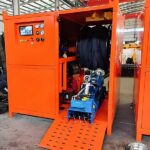
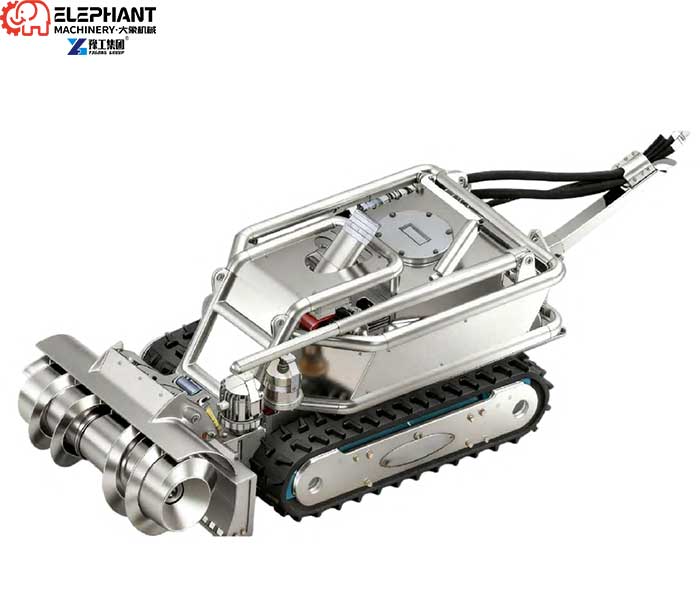
Elephant Machinery customized a remote-controlled sewer dredging robot system combining a high-pressure water jet, powerful breaking head, and hydraulic slurry transfer pump.
The result was a complete sewer sludge removal and desilting solution designed for confined underground wastewater infrastructure.
Sewer Pipe Cleaning Robot Parameters
Elephant Machinery provides different dredging robot configurations for sewer, drainage, culvert, wastewater, and other confined-space sludge removal applications.
| Parameter | YG450 | YG500 | YG600 | YG700 | YG800 | YG900 | YG1200 |
| Robot Dimensions (mm) | ≤1700 × 450 × 450 | 1500 × 500 × 650 | 1500 × 600 × 650 | 1600 × 700 × 650 | 1600 × 850 × 700 | 1650 × 960 × 750 | 1900 × 1200 × 750 |
| Applicable Manhole / Access | ≥600 mm opening | ≥600 mm opening | ≥600 mm opening | ≥700 mm opening | ≥800 mm opening | ≥900 mm opening | Large culvert / open access |
| Dredging Width (mm) | 450 | 500 | 600 | 700 | 800 | 900 | Suitable for large culverts |
| Travel Speed (m/s) | 3–12 | 3–15 | 3–15 | 3–15 | 3–15 | 3–15 | 0–17 m/min |
| Pump Diameter (inch) | 3 | 3 | 3 | 4 | 4 | 4 | 4 or 6 |
| Pump Flow (m³/h) | 50 | 100 | 100 | 160 | 160 | 200 | 250 |
| Pump Head (m) | 0-30 | 0–30 | 0–30 | 0–25 | 0–25 | 0–25 | 0–30 (Horizontal: 100–150 m) |
| Hydraulic Station Dimensions (mm) | 2000 × 1100 × 1500 (recommended) | 2200 × 1200 × 1700 | 2200 × 1200 × 1700 | 2200 × 1200 × 1700 | 2200 × 1200 × 1700 | 2200 × 1200 × 1700 | 2120 × 1240 × 1200 |
| Main Motor Power (kW) | 11–15 kW | 18 | 18 | 22 | 22 | 22 | 45 kW (50 kW) / Diesel 76 kW (123 kW) |
| Hydraulic System Pressure (MPa) | 0–16 | 0–16 | 0–16 | 0–16 | 0–16 | 0–16 | Custom / high-pressure system |
| Particle Size Capacity (mm) | ≤10–20 mm (soft sludge) | 15 | 15 | 40 | 40 | 50 | 0–40 (customizable) |
| Winch Speed (r/min) | 0–10 | 0–10 | 0–10 | 0–10 | 0–10 | 0–10 | 0–10 |
| Pipe Length (m) | 20–30 optional | 30–50 optional | 30–50 optional | 30–50 optional | 30–50 optional | 30–50 optional | 30 m/pack, high-pressure resistant |
| Control System | Wireless Remote Control | Wireless Remote | Wireless Remote | Wireless Remote | Wireless Remote | Wireless Remote | Wireless Remote |
| Lighting System | Underwater LED ×2 | Underwater LED ×2 | Underwater LED ×2 | Underwater LED ×2 | Underwater LED ×2 | Underwater LED ×2 | Underwater LED ×2 |
Final configuration depends on sewer diameter, access opening, sediment type, required slurry consistency, pumping distance, and site conditions.
Get the Right Model for Your Project

Project Challenge: Heavy Sediment Accumulation Inside Municipal Sewers
The affected sewer network included sections from DN600 to DN1200 mm in diameter, with some access points limited to approximately 600 mm manholes.
Long-term accumulation had created thick layers of settled sludge and sediment along the sewer bottom.
In some sections:
- Sludge accumulation reached approximately 30–50 cm
- Sand, organic matter, and grease were mixed with the sediment
- Some deposits became dense and difficult to pump directly
- Reduced sewer capacity increased the risk of localized overflow
- Narrow access points restricted the use of conventional equipment
- Manual cleaning created difficult confined-space working conditions
- Vacuum-only cleaning was not ideal for heavily settled sediment
The contractor needed a system that could do more than simply suction wastewater.
The key requirement was to break and loosen the accumulated sediment, mix it with sufficient water to create a pumpable slurry, and then transport the slurry out of the sewer.
Customized Sewer Sludge Removal Robot System
Based on the pipe diameter, access conditions, sediment characteristics, and pumping distance, Elephant Machinery configured a remote-controlled sewer dredging robot with three core functions:
Break → Add Water → Pump
1. Remote-Controlled Crawler Robot
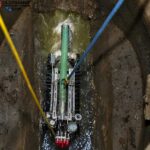
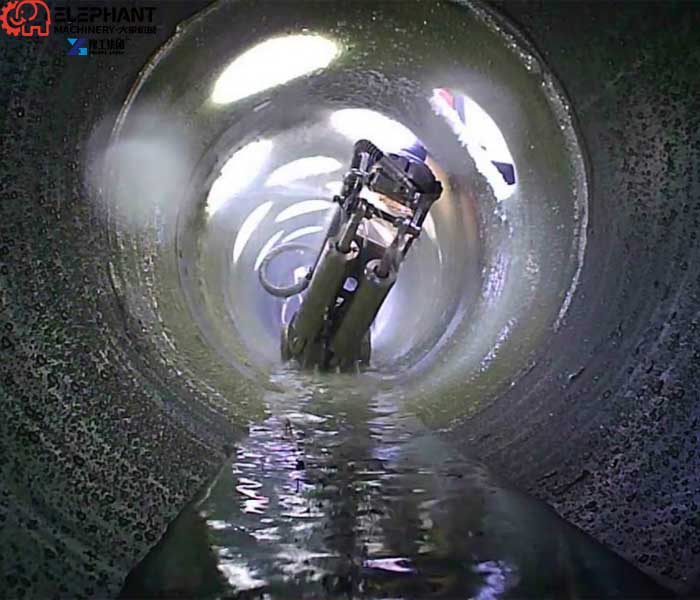
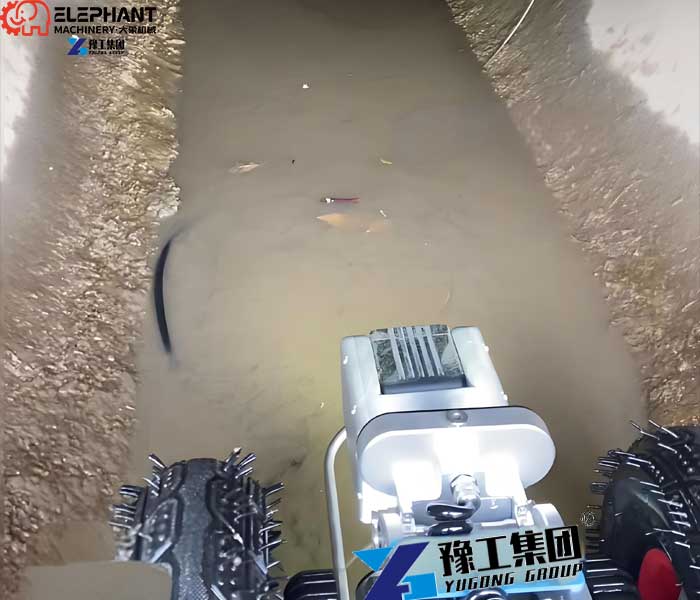
The compact crawler robot moves along the sewer bottom and is operated remotely from outside the confined space.
Key features include:
- Compact crawler design
- Wireless remote control
- Hydraulic drive
- Front-mounted breaking equipment
- Slurry pumping system
- Underwater LED lighting
The system is designed for physical sludge and sediment removal, rather than CCTV pipe inspection.
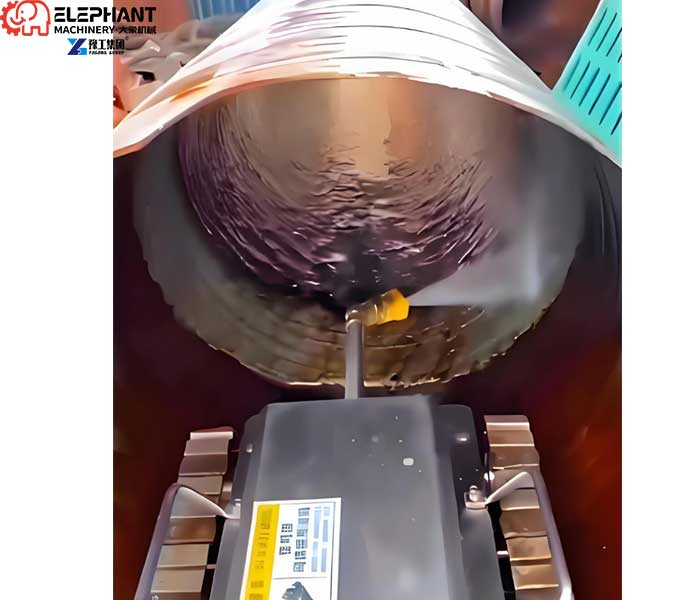
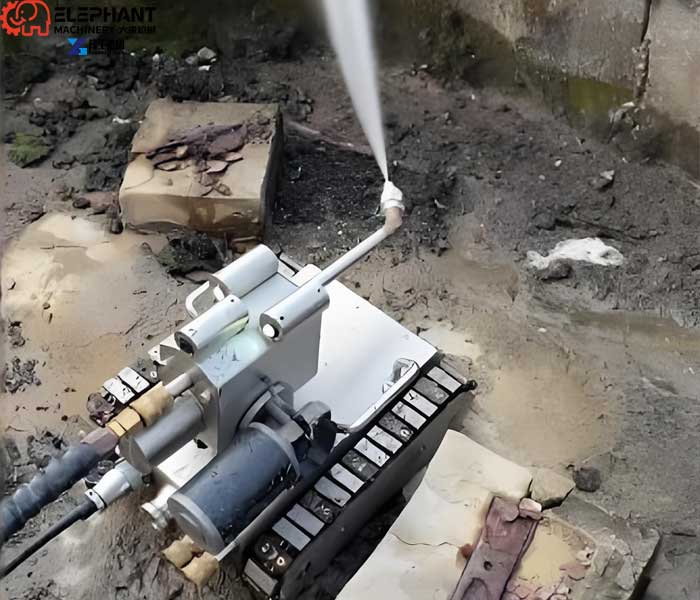
2. High-Pressure Water Jet + Breaking Head
Dense or compacted sediment may be difficult to pump directly. The robot therefore combines a powerful hydraulic breaking head with a high-pressure water jet.
The breaking head loosens compacted sludge, while the water jet adds water and improves slurry flowability. This combination helps turn dense deposits into a pumpable slurry.
The required water addition depends on the sludge characteristics and pumping conditions. For some materials, approximately 30% water content may help achieve suitable pumpability, but the final ratio should be determined according to the actual material and pump configuration.
3. Hydraulic Slurry Transfer Pump
After the sediment has been broken up and sufficiently conditioned with water, the hydraulic slurry transfer pump transports the mixture out of the sewer to the designated collection or treatment area.
The pump can be configured according to:
- Sludge concentration and particle size
- Required flow rate
- Pumping distance and lifting height
- Pipe diameter and site conditions
This integrated system allows the robot to handle heavy, compacted sewer sediment that may be difficult to remove by suction alone.
Customer Feedback from Spain
The Spanish contractor was satisfied with the robot’s performance in the challenging sewer conditions, particularly its ability to work through narrow access points and handle dense, mixed sludge deposits.
Key benefits of the customized system included:
- No personnel entry into the sewer during routine robot operation
- Effective handling of heavy sludge, sand, grease, and organic sediment
- Stable crawler movement in restricted DN600 sewer sections
- Integrated breaking, water conditioning, and slurry pumping in one system
- Modular components that can be adapted to different wastewater and dredging applications
The project also demonstrated the flexibility of the system beyond municipal sewer cleaning. Depending on site requirements, similar robotic configurations can be adapted for sedimentation tank dredging, industrial sludge removal, and culvert cleaning.
This modular approach allows customers to select the crawler size, breaking equipment, water jet, and pumping system according to the actual working conditions rather than using a one-size-fits-all machine.
Conclusion: Customized Robotic Sewer Cleaning for Heavy Sludge
The Spain project shows how a remote-controlled sewer pipe cleaning robot can address difficult sludge removal conditions in municipal wastewater networks.
By combining a powerful breaking head, high-pressure water jet, and hydraulic slurry transfer pump, the system can loosen compacted sediment, condition it into a pumpable slurry, and remove it without requiring personnel to enter the sewer.
More importantly, the equipment can be customized according to the pipe diameter, access opening, sediment characteristics, pumping distance, and required cleaning capacity.
Whether the application involves municipal sewer cleaning, drainage pipelines, sedimentation tanks, or other confined-space sludge removal projects, Elephant Machinery can develop a suitable robotic dredging and sludge removal system based on the actual site conditions.
Send us your pipe diameter, access size, sludge condition, and cleaning distance to discuss a customized sewer cleaning solution.