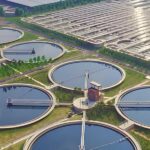

In January 2026, an industrial wastewater treatment company in the United Arab Emirates contacted us regarding a serious operational issue inside their sewage treatment system. The client reported that multiple underground tanks had suffered from long-term sludge accumulation. Over time, the sediment layer had become thick, compacted, and mixed with oily residues and fine sand particles. This significantly reduced the effective storage capacity of the system and negatively impacted wastewater treatment efficiency. At this stage, the client was actively searching for a sewage tank cleaning robot, also referred to in the industry as a sedimentation tank dredging robot, industrial tank cleaning robot, or sludge cleaning robot, to replace inefficient manual and vacuum-based cleaning methods.
Sewage Tank Cleaning Robot Parameters
| Parameter | YG450 | YG500 | YG600 | YG700 | YG800 | YG900 | YG1200 |
| Robot Dimensions (mm) | ≤1700 × 450 × 450 | 1500 × 500 × 650 | 1500 × 600 × 650 | 1600 × 700 × 650 | 1600 × 850 × 700 | 1650 × 960 × 750 | 1900 × 1200 × 750 |
| Applicable Manhole / Access | ≥600 mm opening | ≥600 mm opening | ≥600 mm opening | ≥700 mm opening | ≥800 mm opening | ≥900 mm opening | Large culvert / open access |
| Dredging Width (mm) | 450 | 500 | 600 | 700 | 800 | 900 | Suitable for large culverts |
| Travel Speed (m/s) | 3–12 | 3–15 | 3–15 | 3–15 | 3–15 | 3–15 | 0–17 m/min |
| Pump Diameter (inch) | 3 | 3 | 3 | 4 | 4 | 4 | 4 or 6 |
| Pump Flow (m³/h) | 50 | 100 | 100 | 160 | 160 | 200 | 250 |
| Pump Head (m) | 0-30 | 0–30 | 0–30 | 0–25 | 0–25 | 0–25 | 0–30 (Horizontal: 100–150 m) |
| Hydraulic Station Dimensions (mm) | 2000 × 1100 × 1500 (recommended) | 2200 × 1200 × 1700 | 2200 × 1200 × 1700 | 2200 × 1200 × 1700 | 2200 × 1200 × 1700 | 2200 × 1200 × 1700 | 2120 × 1240 × 1200 |
| Main Motor Power (kW) | 11–15 kW | 18 | 18 | 22 | 22 | 22 | 45 kW (50 kW) / Diesel 76 kW (123 kW) |
| Hydraulic System Pressure (MPa) | 0–16 | 0–16 | 0–16 | 0–16 | 0–16 | 0–16 | Custom / high-pressure system |
| Particle Size Capacity (mm) | ≤10–20 mm (soft sludge) | 15 | 15 | 40 | 40 | 50 | 0–40 (customizable) |
| Winch Speed (r/min) | 0–10 | 0–10 | 0–10 | 0–10 | 0–10 | 0–10 | 0–10 |
| Pipe Length (m) | 20–30 optional | 30–50 optional | 30–50 optional | 30–50 optional | 30–50 optional | 30–50 optional | 30 m/pack, high-pressure resistant |
| Control System | Wireless Remote Control | Wireless Remote | Wireless Remote | Wireless Remote | Wireless Remote | Wireless Remote | Wireless Remote |
| Lighting System | Underwater LED ×2 | Underwater LED ×2 | Underwater LED ×2 | Underwater LED ×2 | Underwater LED ×2 | Underwater LED ×2 | Underwater LED ×2 |
Get the Right Model for Your Project

Site Challenges – Heavy Sludge & Confined Space
After a detailed technical review of the site conditions, the following issues were identified:
- The sludge layer at the bottom of the tank was highly compacted and difficult to remove using standard suction equipment.
- Some tank corners and low-flow zones were completely unreachable by conventional cleaning tools.
- The working environment was classified as a confined space, making human entry extremely dangerous due to toxic gases and oxygen deficiency risks.
- Frequent shutdowns were required for manual cleaning, which caused operational delays and increased maintenance costs.
In summary, the client needed a remote-controlled sewage tank cleaning solution capable of continuous operation in hazardous conditions.
Solution – Industrial Sludge Cleaning Robot System
After evaluating the working conditions, Elephant Machinery proposed a customized dredging robot system specifically designed for confined space sludge removal and wastewater tank cleaning applications.
The solution was based on our YG-series robotic platform, which is widely used for sludge removal operations in sewage tanks and wastewater treatment facilities.
To match the site conditions, we selected a combination of YG450 and YG900 models, ensuring both maneuverability in confined spaces and sufficient pumping capacity for heavy sludge zones.

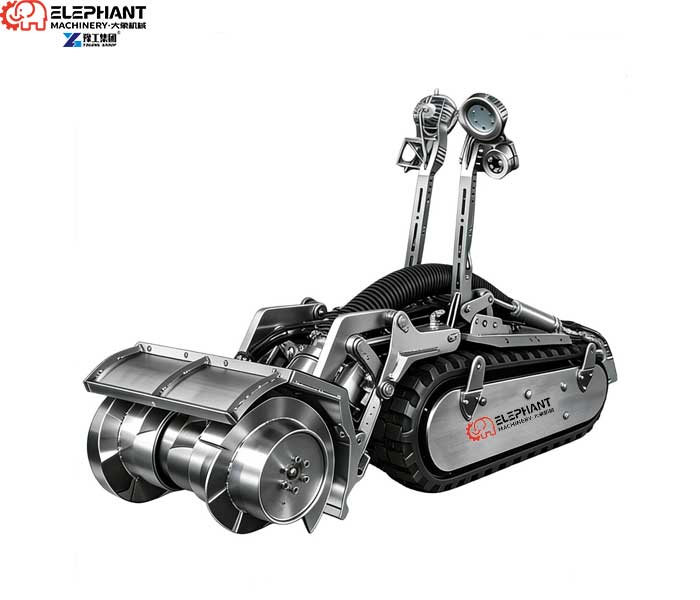
Suitable Equipment – YG450 & YG900 Cleaning Robots
🔹 Compact Structure for Confined Tank Entry
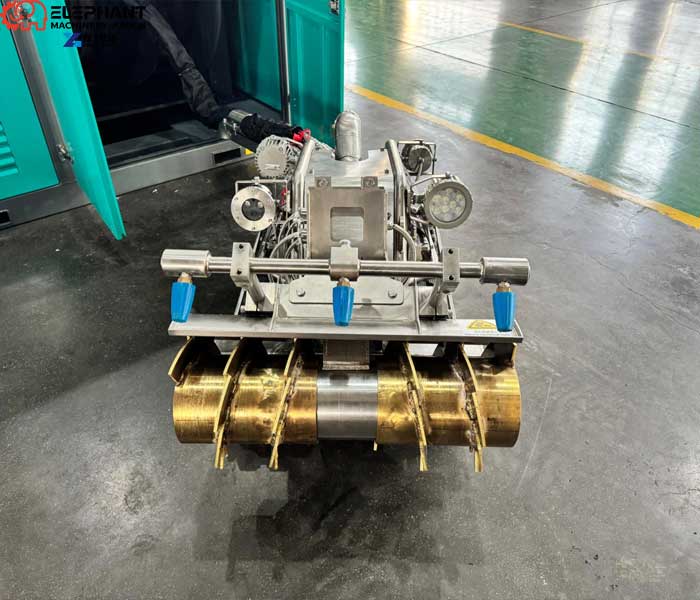
The YG450 model was deployed for standard tank sections. Its compact size of 1700 × 450 × 450 mm allows it to pass through a 600 mm manhole opening, making it suitable for most sewage tank cleaning robot applications.
The YG900 model was used in heavier sludge areas where higher pumping capacity and stronger traction were required.
🔹 High-Efficiency Sludge Pumping System
The dredging robot is equipped with a hydraulic slurry pump system designed for continuous operation under heavy load conditions.
Key performance parameters include:
- Pump flow capacity: up to 160 m³/h
- Pump diameter: 3–4 inch
- Maximum head: up to 30 m
- Solid handling capability: up to 40 mm particles
This allows the system to continuously remove sludge, sand, and mixed industrial waste without clogging or interruption.
🔹 High-Pressure Water Jet for Hardened Sludge Removal
One of the key upgrades in this project was the integration of a high-pressure water jet system.
During operation, many areas inside the tank contained hardened sludge layers that could not be directly suctioned. The high-pressure water jet was used to:
- Break compacted sludge layers at the tank bottom
- Loosen oily and sticky sediment deposits
- Improve suction efficiency of the dredging pump system
- Clean corners and dead zones that were previously inaccessible
This combination of mechanical dredging + hydraulic jetting significantly improved overall cleaning performance.
🔹 Remote Control and Safety Operation
The entire system was operated through a wireless remote-control platform. Operators were able to control the robot safely from outside the tank area, eliminating the need for human entry into hazardous confined spaces.
This feature is especially important for sewage tank cleaning robot applications, where safety regulations strictly limit manual entry.
🔹 Real-Time Visual Monitoring System
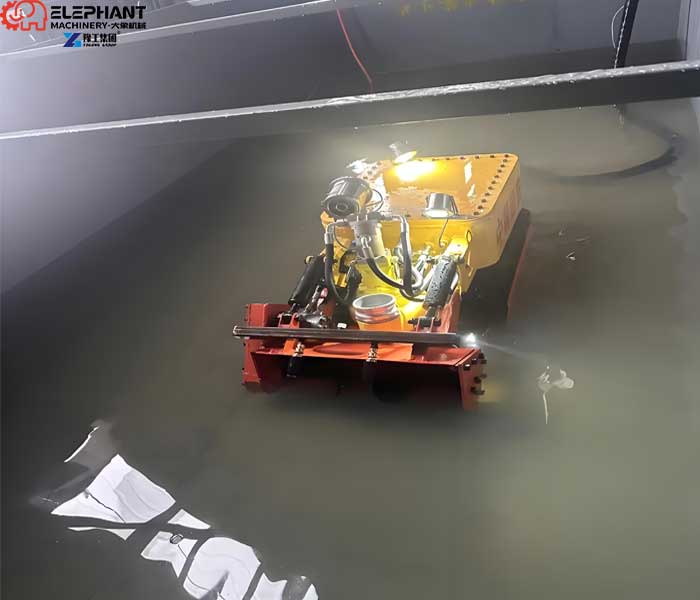
The robot was equipped with underwater LED lighting and real-time visual feedback. This allowed operators to clearly observe sludge conditions inside the tank and adjust the dredging path accordingly.
As a result, even deep sediment zones and hidden corners were fully cleaned during a single operation cycle.

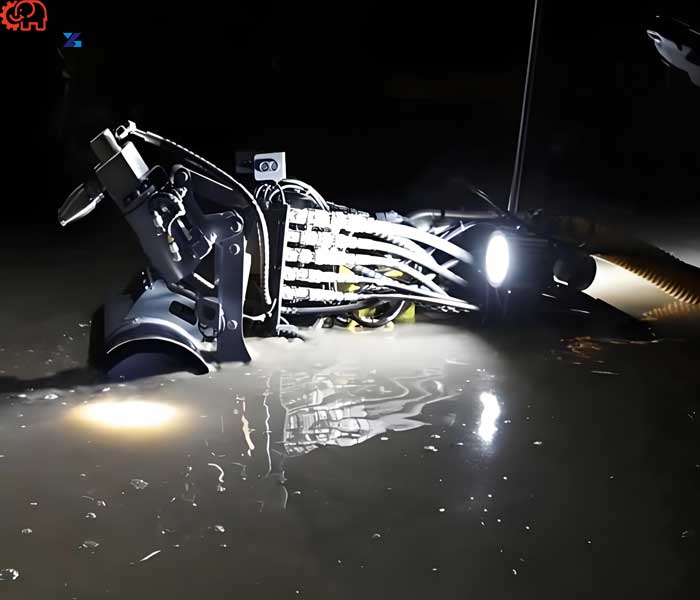
Execution – UAE Project Workflow
After equipment delivery, on-site commissioning was completed efficiently. The system was first tested in a controlled environment before full deployment into operational tanks.
The cleaning process was carried out in stages:
- The robot entered the tank through the manhole access.
- High-pressure water jet was used to loosen hardened sludge.
- The dredging pump continuously extracted the slurry mixture.
- Discharge pipelines transported sludge to the treatment area.
- Multiple passes ensured full coverage of tank bottom and corners.
The entire process was stable, continuous, and required no human entry into the tank.
Results – Improved Tank Cleaning Efficiency
After implementation, the client achieved significant improvements in operational efficiency.
- The sludge removal cycle was reduced by more than 60% compared to previous methods.
- Tank capacity was fully restored after complete sediment removal.
- Manual entry into confined spaces was completely eliminated.
- Cleaning quality improved, especially in deep and corner areas.
Overall, the sewage tank cleaning robot system significantly improved both safety and operational efficiency.

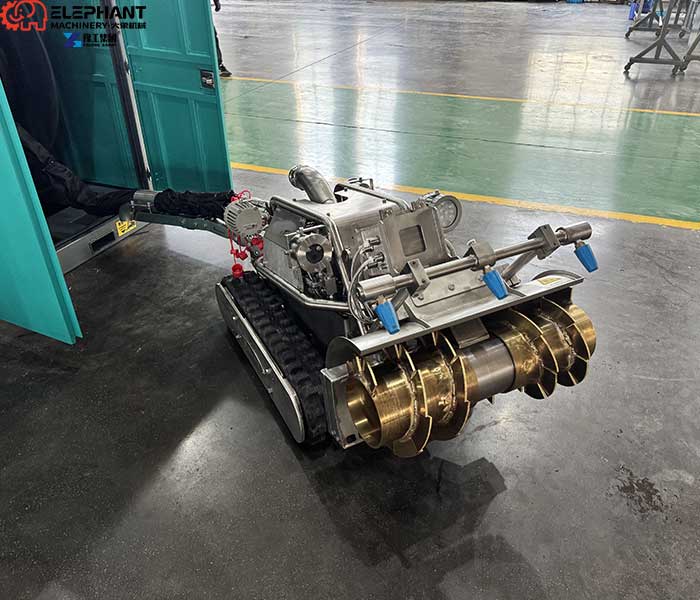
Customer Feedback – UAE Project Review
The client provided positive feedback after project completion.
“Before this project, we had serious sludge buildup in our sewage tanks, and traditional cleaning methods were not effective. After using this system, we were impressed by its stable performance even under heavy sludge conditions.
The combination of high-pressure water jetting, stainless steel sharp auger, and the dredging pump made a big difference in breaking and removing compacted sludge.
What we value most is the remote control operation. Our team no longer needs to enter confined spaces, and real-time monitoring makes the whole process much safer and more efficient.”
Conclusion – Sewage Tank Cleaning Robot Solution
This UAE project demonstrates how a modern sewage tank cleaning robot system can effectively replace traditional manual cleaning methods in industrial wastewater environments.
By combining high-pressure water jet technology, continuous slurry pumping, and remote-controlled operation, Elephant Machinery delivered a safe, efficient, and fully adaptable solution for complex sludge removal challenges in confined tank environments.