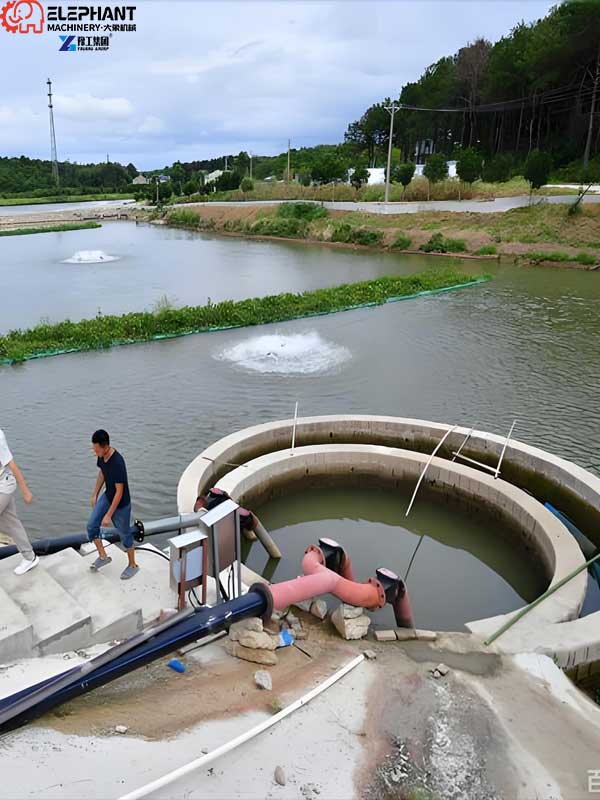
Healthy fish production starts with a clean pond bottom. In commercial fish farms, sludge gradually accumulates from uneaten feed, fish manure, dead algae, aquatic weeds, and suspended organic matter. As the sludge layer becomes thicker, dissolved oxygen decreases while ammonia, nitrite, and harmful bacteria increase.
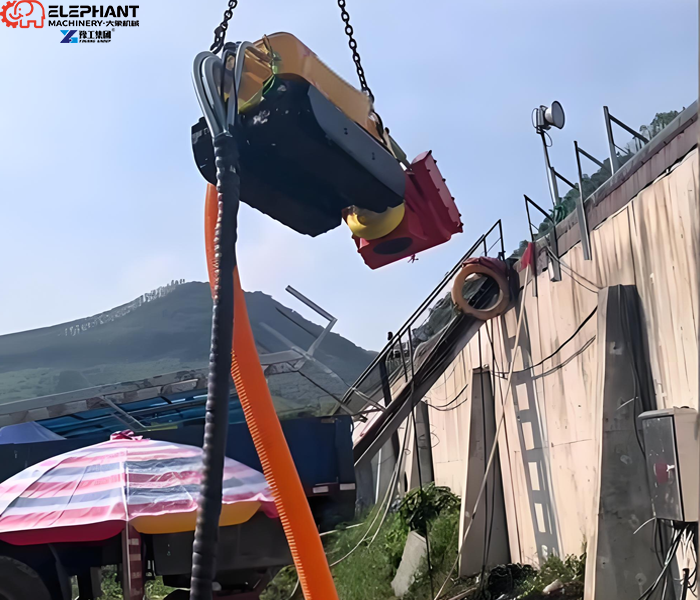
The fish pond dredging robot is specifically designed to remove bottom sludge efficiently without draining the pond or interrupting daily farm operations. Equipped with a crawler mobility system, hydraulic remote sludge pumping system, and intelligent remote control, it continuously removes sediment while protecting fish and pond infrastructure.
Whether managing carp, tilapia, catfish, grass carp, or mixed-species ponds, the robot helps maintain stable water quality, healthier fish, and lower operating costs.
Fish Pond Dredging Robot Parameters
| Parameter | YG450 | YG500 | YG600 | YG700 | YG800 | YG900 | YG1200 |
| Robot Dimensions (mm) | ≤1700 × 450 × 450 | 1500 × 500 × 650 | 1500 × 600 × 650 | 1600 × 700 × 650 | 1600 × 850 × 700 | 1650 × 960 × 750 | 1900 × 1200 × 750 |
| Applicable Manhole / Access | ≥600 mm opening | ≥600 mm opening | ≥600 mm opening | ≥700 mm opening | ≥800 mm opening | ≥900 mm opening | Large culvert / open access |
| Dredging Width (mm) | 450 | 500 | 600 | 700 | 800 | 900 | Suitable for large culverts |
| Travel Speed (m/s) | 3–12 | 3–15 | 3–15 | 3–15 | 3–15 | 3–15 | 0–17 m/min |
| Pump Diameter (inch) | 3 | 3 | 3 | 4 | 4 | 4 | 4 or 6 |
| Pump Flow (m³/h) | 50 | 100 | 100 | 160 | 160 | 200 | 250 |
| Pump Head (m) | 0-30 | 0–30 | 0–30 | 0–25 | 0–25 | 0–25 | 0–30 (Horizontal: 100–150 m) |
| Hydraulic Station Dimensions (mm) | 2000 × 1100 × 1500 (recommended) | 2200 × 1200 × 1700 | 2200 × 1200 × 1700 | 2200 × 1200 × 1700 | 2200 × 1200 × 1700 | 2200 × 1200 × 1700 | 2120 × 1240 × 1200 |
| Main Motor Power (kW) | 11–15 kW | 18 | 18 | 22 | 22 | 22 | 45 kW (50 kW) / Diesel 76 kW (123 kW) |
| Hydraulic System Pressure (MPa) | 0–16 | 0–16 | 0–16 | 0–16 | 0–16 | 0–16 | Custom / high-pressure system |
| Particle Size Capacity (mm) | ≤10–20 mm (soft sludge) | 15 | 15 | 40 | 40 | 50 | 0–40 (customizable) |
| Winch Speed (r/min) | 0–10 | 0–10 | 0–10 | 0–10 | 0–10 | 0–10 | 0–10 |
| Pipe Length (m) | 20–30 optional | 30–50 optional | 30–50 optional | 30–50 optional | 30–50 optional | 30–50 optional | 30 m/pack, high-pressure resistant |
| Control System | Wireless Remote Control | Wireless Remote | Wireless Remote | Wireless Remote | Wireless Remote | Wireless Remote | Wireless Remote |
| Lighting System | Underwater LED ×2 | Underwater LED ×2 | Underwater LED ×2 | Underwater LED ×2 | Underwater LED ×2 | Underwater LED ×2 | Underwater LED ×2 |
Why Fish Ponds Require Regular Sludge Removal?
Fish ponds naturally produce organic waste every day. Without regular cleaning, this material settles to the bottom and gradually forms compact sludge layers.
Common sludge sources include:
- Uneaten fish feed
- Fish feces
- Dead algae
- Decaying aquatic plants
- Wind-blown sediment
- Runoff entering the pond
Over time, sludge begins consuming dissolved oxygen and releases harmful gases such as hydrogen sulfide and methane.
Typical problems include:
- Poor water transparency
- Low dissolved oxygen
- Higher ammonia concentration
- Frequent algae blooms
- Increased fish disease
- Slow growth rate
- Difficult harvesting
Removing sludge before it becomes heavily compacted is significantly more economical than restoring a neglected pond.
Why Traditional Pond Cleaning Is Inefficient?
Many fish farms still rely on conventional cleaning methods.
Draining the pond
Although effective, draining requires stopping production for several weeks. Fish must be transferred or harvested early, resulting in labor costs and production losses.
Excavator cleaning
Excavators can remove sludge quickly but often damage pond banks and HDPE liners. Heavy equipment also struggles to reach soft pond bottoms without becoming stuck.
Manual cleaning
Manual dredging is labor-intensive, slow, and inconsistent, making it unsuitable for medium and large fish farms.
For farms operating continuously, these methods increase costs and reduce annual production efficiency.
How the Fish Pond Dredging Robot Works?
The robot combines several systems into one integrated cleaning solution.
Crawler Travel System
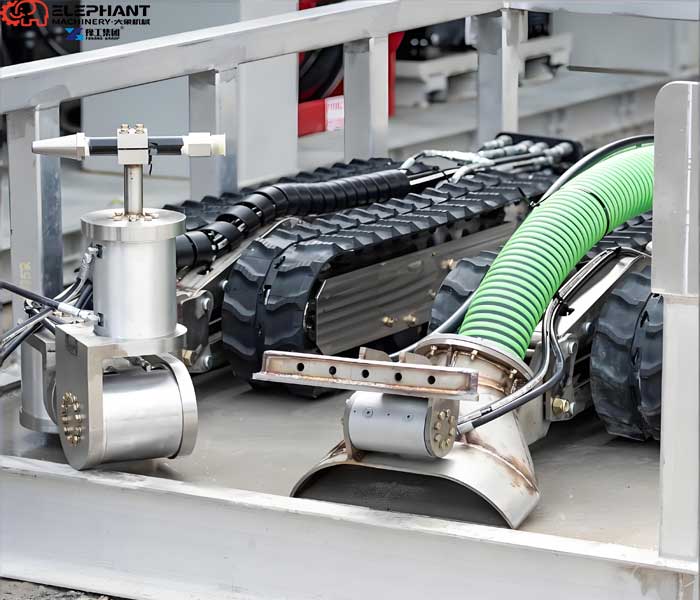
A low-ground-pressure crawler chassis travels steadily across soft pond bottoms without sinking, allowing reliable operation in earthen and HDPE-lined ponds.
Hydraulic Remote Sludge Pumping System
Instead of simply stirring sediment, the robot uses a high-capacity hydraulic remote pumping system to continuously transport sludge through discharge pipelines over long distances.
This enables sludge to be transferred directly to settling ponds, drying beds, or storage areas without secondary handling, reducing labor and improving overall cleaning efficiency.
Cutter and Agitation Mechanism
For compacted sludge or accumulated organic deposits, the front-mounted cutter loosens the material before suction, ensuring smooth pumping and minimizing blockages.
Intelligent Remote Control
Operators monitor movement and cleaning progress remotely, eliminating the need to enter muddy or hazardous pond environments.
Key Features Designed for Fish Farms
1. Hydraulic Remote Sludge Pumping
Continuously transports sludge over long distances without interrupting pond operation, making it ideal for medium and large commercial fish farms.
2. Low-Turbidity Cleaning
Carefully controls water disturbance to maintain visibility and reduce stress on fish during cleaning.
3. High-Efficiency Anti-Clog Pump
Handles feed residue, algae, and organic sludge with reliable continuous operation.
4. Soft-Ground Crawler Chassis
Provides stable movement on soft pond bottoms while protecting HDPE liners and pond structures.
5. Adjustable Cleaning Capacity
Pump output and suction intensity can be adjusted according to pond size and sludge thickness.
6. Remote-Controlled Operation
One operator can safely complete cleaning from the pond bank, reducing labor requirements.
7. Modular Dredging Attachments
Different cutter heads and suction inlets are available for various sludge conditions.
Typical Applications of Fish Pond Dredging Robot
The fish pond dredging robot is suitable for:
- Carp farming ponds
- Tilapia farms
- Catfish ponds
- Grass carp ponds
- Freshwater aquaculture bases
- Recreational fishing lakes
- Reservoir fish breeding ponds
- Earthen ponds
- HDPE-lined fish ponds
- Large commercial aquaculture parks
Return on Investment
For many fish farms, sludge is an invisible operating cost.
Removing sludge regularly can help:
- Increase dissolved oxygen
- Improve feed conversion efficiency
- Reduce disease treatment expenses
- Extend pond service life
- Reduce annual labor costs
- Improve harvest efficiency
For a medium-sized fish farm, replacing manual cleaning with robotic dredging can significantly reduce annual maintenance expenses while avoiding production downtime.Know more about aquaculture pond dredging robot.
How to Select the Right Fish Pond Dredging Robot?
Choosing the correct model depends on several factors.
Consider:
- Pond area
- Average water depth
- Sludge thickness
- Required pumping distance
- Daily cleaning capacity
- Power source availability
- Earthen or HDPE-lined pond
Providing these details allows engineers to recommend the most suitable pump capacity, crawler configuration, and discharge system.
FAQ about Fish Pond Dredging Robot
Can the robot clean ponds while fish remain inside?
Yes. The low-turbidity cleaning design allows sludge removal without draining the pond or removing fish.
Will the crawler damage the pond liner?
No. Rubber crawler tracks distribute weight evenly and are suitable for HDPE-lined ponds.
What types of sludge can it remove?
Fish manure, feed residue, algae deposits, decayed vegetation, and organic sediment.
How far can sludge be pumped?
The hydraulic remote pumping system can be configured for different discharge distances according to project requirements.
Can one robot clean multiple ponds?
Yes. The robot can be moved between ponds, making it suitable for farms with multiple production ponds.
Is customization available?
Yes. Pump capacity, crawler size, discharge distance, cutter configuration, and control systems can all be customized.
Keep Your Fish Ponds Cleaner, Healthier, and More Productive
Our fish pond dredging robot provides an efficient, safe, and cost-effective solution for sludge removal in commercial aquaculture.
Whether you operate a small freshwater fish farm or a large aquaculture project, our engineering team can recommend the right model based on your pond size, sludge characteristics, and production goals.
Contact us today to receive a customized solution, technical consultation, and quotation.