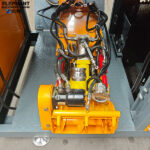

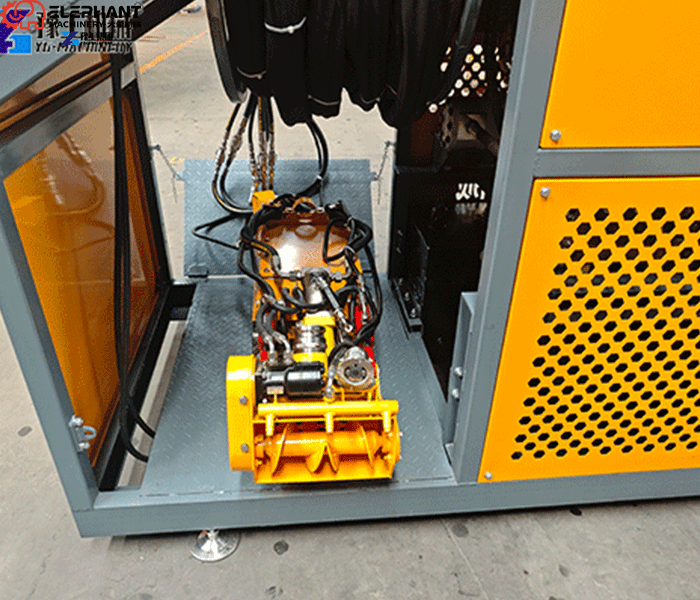
When conventional dredging equipment cannot pass through a narrow access opening, removing accumulated sludge from an industrial tank becomes a difficult maintenance task. In this Brunei project, the customer needed a portable robotic dredge that could enter an industrial tank through an access opening measuring only 88 cm × 81 cm.
Elephant Dredging customized a compact dredging robot with an overall diameter of approximately 40 cm, together with a spiral cutting head, high-pressure water jet, underwater LED camera, and remote-control system. The customized solution allowed the customer to lower the robot into the tank, remove stubborn sediment remotely, and monitor the operation clearly from outside.
The result was a practical solution to a very specific problem: how to clean a difficult-to-access tank without sending workers into the tank or using oversized dredging equipment.
Portable Robotic Dredge Parameters
| Parameter | YG450 | YG500 | YG600 | YG700 | YG800 | YG900 | YG1200 |
| Robot Dimensions (mm) | ≤1700 × 450 × 450 | 1500 × 500 × 650 | 1500 × 600 × 650 | 1600 × 700 × 650 | 1600 × 850 × 700 | 1650 × 960 × 750 | 1900 × 1200 × 750 |
| Applicable Manhole / Access | ≥600 mm opening | ≥600 mm opening | ≥600 mm opening | ≥700 mm opening | ≥800 mm opening | ≥900 mm opening | Large culvert / open access |
| Dredging Width (mm) | 450 | 500 | 600 | 700 | 800 | 900 | Suitable for large culverts |
| Travel Speed (m/s) | 3–12 | 3–15 | 3–15 | 3–15 | 3–15 | 3–15 | 0–17 m/min |
| Pump Diameter (inch) | 3 | 3 | 3 | 4 | 4 | 4 | 4 or 6 |
| Pump Flow (m³/h) | 50 | 100 | 100 | 160 | 160 | 200 | 250 |
| Pump Head (m) | 0-30 | 0–30 | 0–30 | 0–25 | 0–25 | 0–25 | 0–30 (Horizontal: 100–150 m) |
| Hydraulic Station Dimensions (mm) | 2000 × 1100 × 1500 (recommended) | 2200 × 1200 × 1700 | 2200 × 1200 × 1700 | 2200 × 1200 × 1700 | 2200 × 1200 × 1700 | 2200 × 1200 × 1700 | 2120 × 1240 × 1200 |
| Main Motor Power (kW) | 11–15 kW | 18 | 18 | 22 | 22 | 22 | 45 kW (50 kW) / Diesel 76 kW (123 kW) |
| Hydraulic System Pressure (MPa) | 0–16 | 0–16 | 0–16 | 0–16 | 0–16 | 0–16 | Custom / high-pressure system |
| Particle Size Capacity (mm) | ≤10–20 mm (soft sludge) | 15 | 15 | 40 | 40 | 50 | 0–40 (customizable) |
| Winch Speed (r/min) | 0–10 | 0–10 | 0–10 | 0–10 | 0–10 | 0–10 | 0–10 |
| Pipe Length (m) | 20–30 optional | 30–50 optional | 30–50 optional | 30–50 optional | 30–50 optional | 30–50 optional | 30 m/pack, high-pressure resistant |
| Control System | Wireless Remote Control | Wireless Remote | Wireless Remote | Wireless Remote | Wireless Remote | Wireless Remote | Wireless Remote |
| Lighting System | Underwater LED ×2 | Underwater LED ×2 | Underwater LED ×2 | Underwater LED ×2 | Underwater LED ×2 | Underwater LED ×2 | Underwater LED ×2 |
Get the Right Model for Your Project
Project Background: Limited Access Made Tank Cleaning Difficult
The Brunei customer needed to remove accumulated sludge and sediment from an industrial tank.
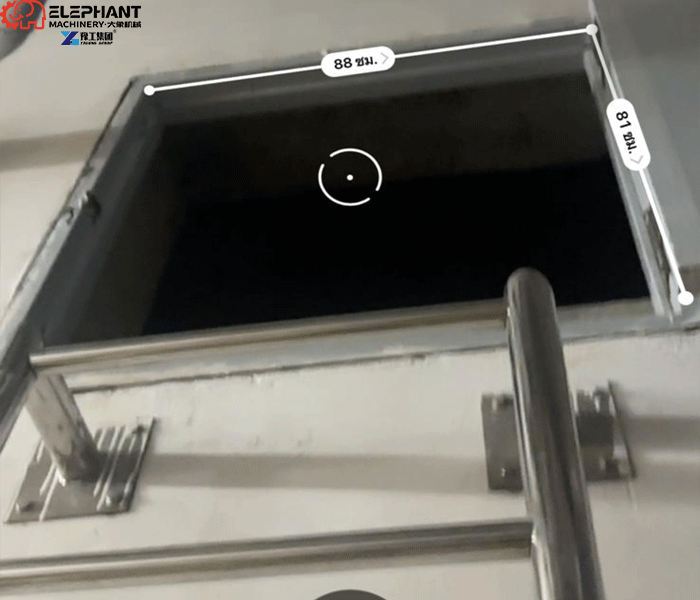
The biggest challenge was the tank’s access point. The available top inspection opening was approximately:
88 cm × 81 cm
This significantly restricted the choice of cleaning equipment. Conventional excavators and large dredging machines could not be brought directly into the tank, while manual cleaning would require workers to work inside a confined industrial environment.
The customer therefore needed a dredging machine that was:
- Compact enough to pass through the access opening
- Powerful enough to remove accumulated sediment
- Suitable for stubborn, compacted deposits
- Remotely operated
- Equipped with a visual monitoring system
This was not a standard dredging requirement. The equipment needed to be customized around the customer’s actual access conditions.
Elephant Dredging’s Portable Robotic Dredge Solution
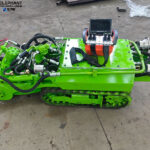
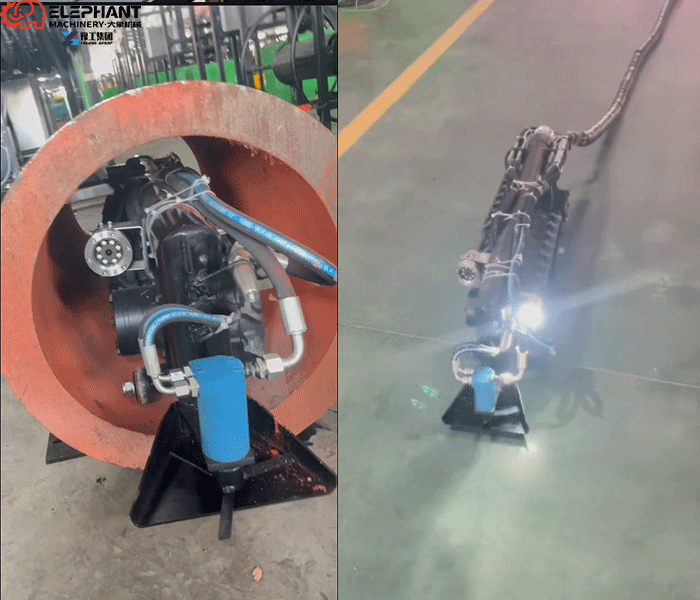
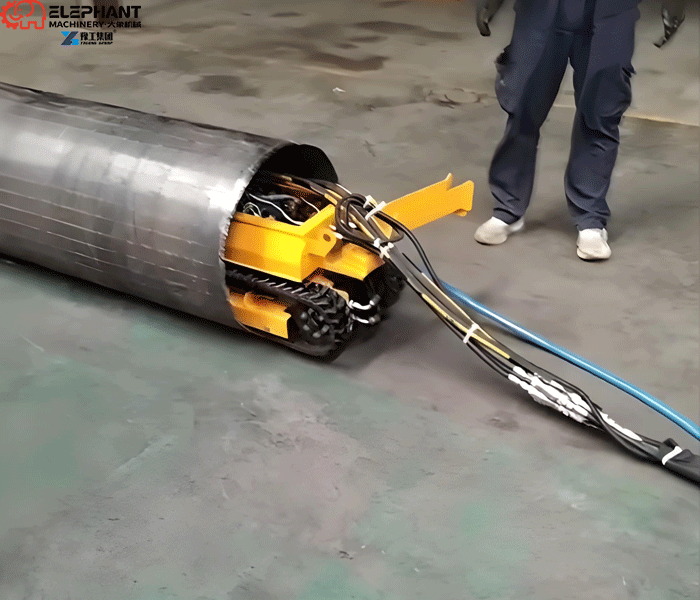
Based on the customer’s access dimensions and cleaning requirements, Elephant Dredging customized a portable robotic dredge with an approximately 40 cm diameter compact structure.
The smaller body allowed the robot to be transported through the restricted access opening while retaining the core functions required for sediment removal.
The customized configuration included:
1.Compact 40 cm Robot Design
The robot was designed with an approximately 40 cm diameter, leaving sufficient clearance for the customer’s 88 × 81 cm access opening.
This compact configuration was the key to getting the dredging equipment into the tank.
2.Spiral Cutting Head for Compacted Sediment
The tank contained accumulated sediment that could not be efficiently removed by suction alone.
A spiral cutting head was therefore installed at the front of the robot to break up and loosen stubborn, compacted deposits before they entered the suction system.
3.High-Pressure Water Jet
A high-pressure water jet was added to assist with loosening sediment and cleaning the working area.
The combination of the spiral head and water jet helped improve sediment mobilization and supported more continuous removal.
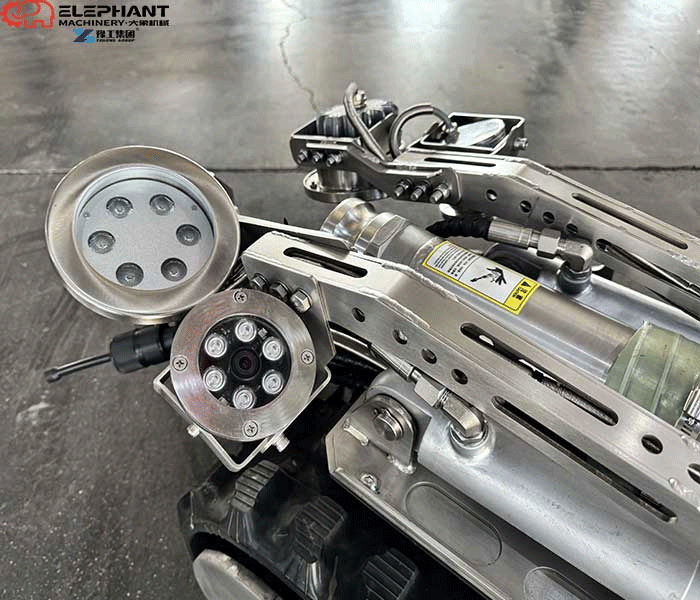
4.LED Camera for Real-Time Monitoring
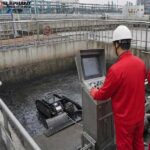
An underwater LED camera was installed on the robot so the operator could see the working area during operation.
This was particularly important in the enclosed tank, where direct visibility from outside was limited.
The external display allowed the customer to monitor the robot’s position and cleaning process in real time.
How the Portable Robotic Dredge Was Used?
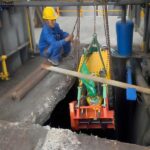
After receiving the equipment, the customer lifted the dredging robot through the top access opening and positioned it inside the tank.
The cleaning process was then performed remotely.
Instead of sending personnel into the tank to manually remove sediment, the operator controlled the robot from outside. The robot moved through the sediment, while the spiral cutting head and high-pressure water jet helped loosen accumulated deposits.
The suction system then transferred the loosened sludge through the connected discharge pipeline.
At the same time, the LED camera transmitted the working scene to the external display.
This gave the operator a clear view of the cleaning process without needing to physically enter the tank.
The working process can be summarized as:
Lift the robot into the tank → Remote operation → Loosen compacted sediment → Suction and transfer sludge → Monitor through the external display
This configuration made the equipment particularly suitable for a tank where access, visibility, and working space were the main challenges.
Why a Portable Robotic Dredge Was the Right Choice?
For this project, the main advantage was not simply pumping capacity. It was the robot’s ability to enter a restricted-access industrial facility while maintaining remote dredging capabilities.
A conventional dredger may perform well in open water, but large equipment becomes difficult to transport and deploy when the only available access is a relatively small inspection opening.
The customized portable robotic dredge solved this problem by separating the equipment into two practical requirements:
- Compact entry: The approximately 40 cm robot could be lowered through the customer’s 88 × 81 cm opening.
- Remote cleaning: Once inside, the operator could control the robot externally and monitor the operation through the camera display.
This approach can be considered for similar applications where industrial tanks, water facilities, or other structures have limited access and accumulated sludge or sediment.
Customer Feedback After Delivery
After receiving the customized dredging robot, the customer successfully lowered the equipment into the tank and carried out the cleaning operation using the remote-control system.
The external display provided a clear view of the robot’s operation, while the customized cutting and water-jet configuration helped address the accumulated sediment.
The customer gave positive feedback after using the equipment, confirming that the customized configuration effectively addressed the original access and cleaning challenges.
For Elephant Dredging, this project also demonstrates an important principle: a dredging robot does not always need to be large to be effective. For restricted-access applications, the right compact configuration can be more valuable than simply increasing equipment size.
offering one fixed machine for every project, Elephant Dredging evaluates factors such as access opening, robot dimensions, sediment conditions, water depth, discharge distance, and working environment before recommending a suitable configuration.

FAQ About Portable Robotic Dredge
1.What is a Portable Robotic Dredge?
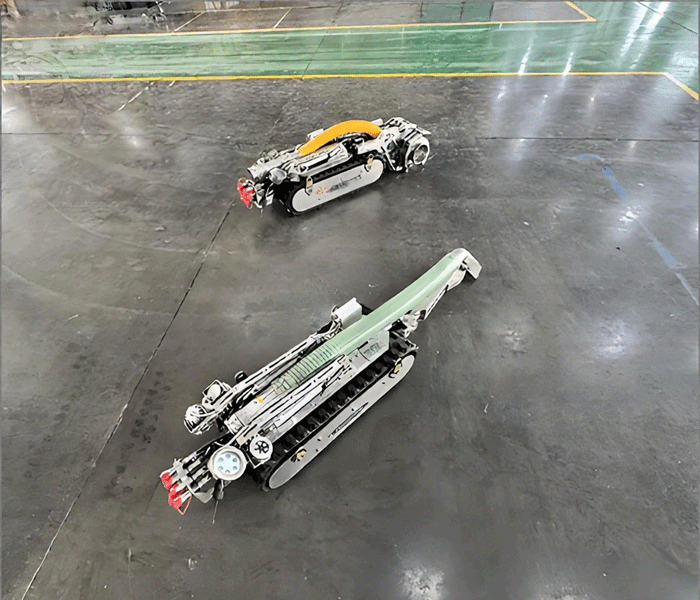
A portable robotic dredge is a compact remotely operated dredging machine designed to remove sludge and sediment from locations where conventional dredging equipment is difficult to access or deploy.
2.Can a portable robotic dredge enter a narrow access opening?
Yes, when the robot is appropriately configured for the opening dimensions. In this Brunei project, Elephant Dredging customized a robot with an approximately 40 cm diameter to pass through an 88 × 81 cm access opening.
3.Can the robot remove compacted sludge?
Yes. A spiral cutting head can be configured to loosen compacted sediment before suction, while a high-pressure water jet can assist with sediment loosening and cleaning.
4.How does the operator monitor the robot inside the tank?
An LED camera installed on the robot transmits the working view to an external display, allowing the operator to monitor the cleaning process remotely.
5.Can Elephant Dredging customize a robotic dredge for a specific tank?
Yes. The robot can be customized according to the access opening, tank dimensions, sediment characteristics, required pumping capacity, discharge distance, and other site conditions.
Elephant Dredging: Customized Robotic Dredging Solutions
This Brunei project shows how a portable robotic dredge can solve a dredging problem that conventional equipment cannot easily address.
With an approximately 40 cm compact body, spiral cutting head, high-pressure water jet, LED camera, and remote-control system, the customized robot could be lowered through the customer’s 88 × 81 cm access opening and operated remotely inside the tank.
For industrial tanks and other restricted-access facilities, the key is not simply choosing a larger dredging machine. It is choosing a compact configuration that fits the site while providing the required sediment removal capability.
Have a narrow-access tank or difficult-to-reach sediment removal project? Contact Elephant Dredging with your access dimensions, tank conditions, and sediment requirements for a customized robotic dredging solution.